

What they are, how to read them, and why they are essential for workplace safety
Safety Data Sheets are essential documents for managing chemical products in the workplace. Understanding their content is crucial to assess risks, protect workers, comply with regulatory requirements, and properly handle hazardous substances and mixtures.
For those involved in health, safety, and environment (HSE), the Safety Data Sheet is not just a technical attachment, but an indispensable operational tool. Yet, in many organizations, it is still archived without being truly used.
In this article, we will look at what Safety Data Sheets are, what they are used for, how to read them, and why digital SDS management can make a real difference.
What are Safety Data Sheets
A Safety Data Sheet, often referred to as an SDS, is a document that provides essential information about a hazardous substance or mixture.
It is designed to clearly communicate:
- the hazards of the product;
- preventive measures;
- correct usage methods;
- storage requirements;
- actions to take in case of emergency;
- information for disposal and transport.
In practice, the SDS helps companies use chemical products safely and responsibly.
What is a Safety Data Sheet used for
Safety Data Sheets are essential for all companies that use industrial detergents, solvents, paints, reagents, additives, chemical mixtures, or other potentially hazardous substances.
An SDS is concretely used to:
- identify hazards associated with the product;
- determine required personal protective equipment (PPE);
- verify correct storage conditions;
- support chemical risk assessment;
- define emergency procedures;
- prevent handling errors;
- properly manage waste resulting from product use.
Without proper reading of Safety Data Sheets, there is a real risk of underestimating exposures, chemical incompatibilities, and necessary preventive measures.
Who must provide the Safety Data Sheet
The Safety Data Sheet must be provided by the supplier of the substance or mixture when required by applicable regulations.
The document must be:
- available in the local language (Italian for the Italian market);
- consistent with product classification and labeling;
- updated when new relevant information becomes available;
- accessible to professional users of the product.
However, for companies, receiving it is not enough. It is necessary to verify that the SDS is up to date, complete, and specifically related to the product actually in use.
How to read a Safety Data Sheet
Many users search online for how to read a Safety Data Sheet, but often face long and highly technical documents. In reality, learning how to properly consult an SDS is essential for workplace safety.
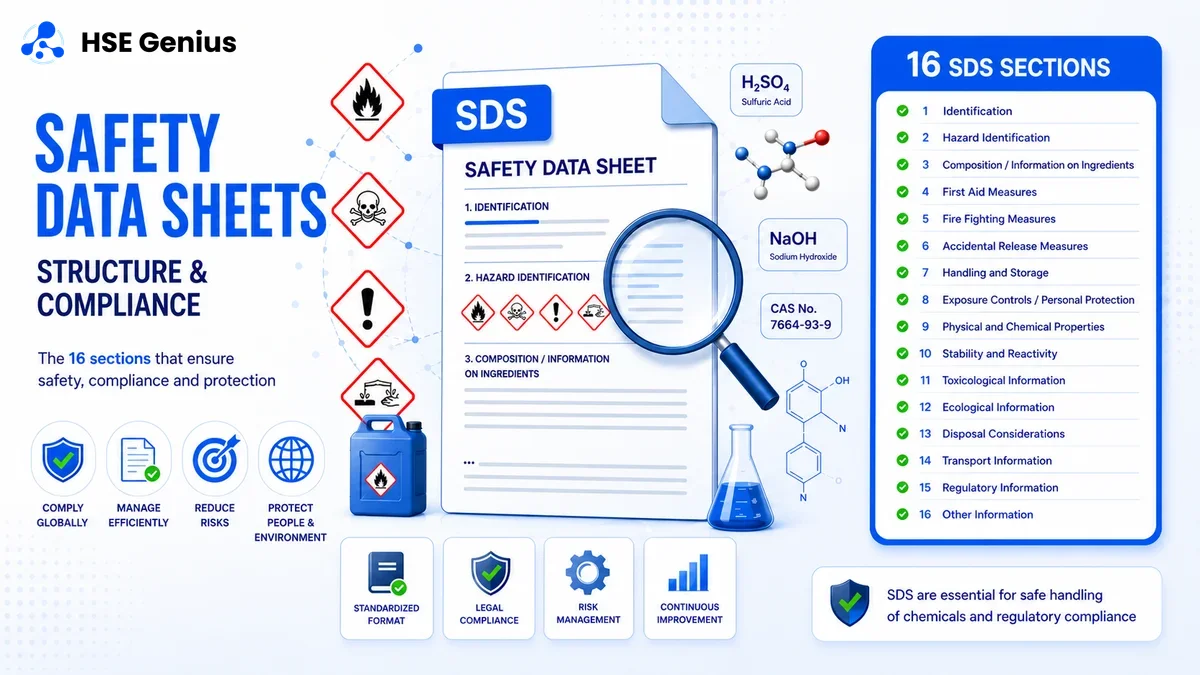
Safety Data Sheets are structured into 16 standardized sections, each with a specific function:
- *Identification of the substance/mixture and of the company***Product name, recommended uses, and supplier details.
- Hazard identification****Classification, pictograms, signal words, and main risks.
- Composition/information on ingredients****Substance or mixture composition and relevant components.
- First aid measures****Actions to take in case of contact, inhalation, or ingestion.
- Firefighting measures****Suitable extinguishing media and combustion hazards.
- Accidental release measures****Procedures in case of spills or leaks.
- Handling and storage****Safe usage and storage instructions.
- Exposure controls/personal protection****One of the most important sections, including exposure limits and recommended PPE.
- Physical and chemical properties****Key technical characteristics.
- Stability and reactivity****Conditions to avoid and possible hazardous reactions.
- Toxicological information****Potential health effects.
- Ecological information****Environmental impact data.
- Disposal considerations****Proper waste management.
- Transport information****ADR and other transport classifications.
- Regulatory information****Applicable regulations.
- Other information****Final notes, revisions, and hazard statement explanations.