

Real Risks and What to Do Now
Giulia, the HSE manager at a plant integrating a small electrolyzer to produce hydrogen for industrial furnaces, applies the precautionary principle. Before starting up the system, she requests a safety review, updates the emergency plan, and organizes short training for the technicians. That day Giulia turns uncertainty into operational control, making the site ready for the new energy challenge.
This article explains, with a practical and direct tone for HSE managers, why hydrogen requires attention today, which rules and guidelines to follow, which mistakes to avoid, and which concrete actions to implement immediately.
What Hydrogen Is and Where It Is Found in Industry
Hydrogen is the fastest-growing energy carrier in the industrial sector.**It is used as:
- a chemical feedstock,
- a fuel for thermal processes,
- an energy storage medium,
- a source for fuel cells.
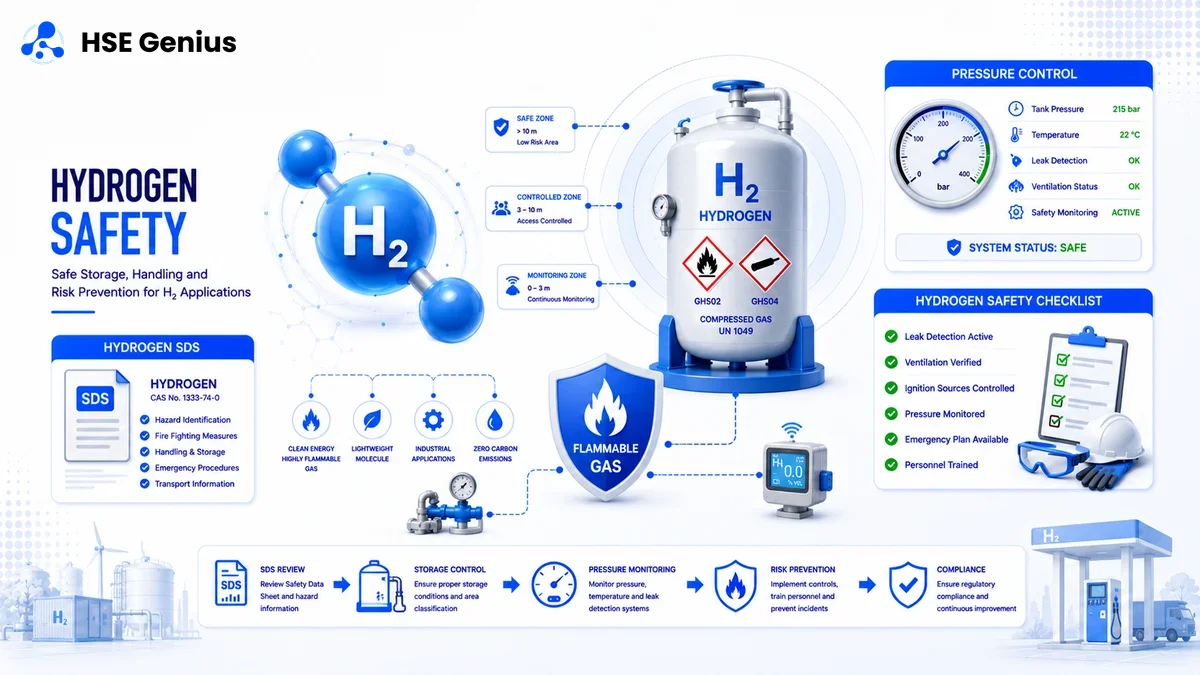
Hydrogen offers advantages such as high energy density by mass, but also properties that require strict controls: it is lightweight, has a wide flammability range, disperses quickly in open spaces, and tends to accumulate in confined areas if ventilation is insufficient. Allianz Commercialh2tools.org
Current Standards and Guidelines (What to Follow Immediately)
The design, installation, and operation of hydrogen systems are based on internationally recognized technical codes and European guidelines:
- NFPA 2, Hydrogen Technologies Code** provides technical requirements for hydrogen generation, storage, piping, and use (2023 edition with ongoing technical updates). nfpa.org
- In Europe, the Clean Hydrogen / European Hydrogen Safety Panel (EHSP) publishes guidelines and safety plan templates for EU-scale projects. These documents support risk planning and assessment for electrolysis and storage initiatives. Clean Hydrogen Partnership
- National authorities (e.g., HSE UK) integrate regulations such as DSEAR and provide operational tools for area classification and ignition source management. hse.gov.uk – solutions.hse.gov.uk
These sources form the foundation for the technical and procedural decisions every HSE manager should adopt.
Real Risks and Case-Based Lessons (Operational Takeaways)
Technical literature and specialist reports highlight the possibility of jet fires, deflagrations, and explosions if hydrogen is released under unfavorable conditions. Probabilistic studies show scenarios with significant damage likelihood in the event of failures in high-pressure systems.
These analyses lead to three concrete lessons for the field: design systems to limit the amount of hydrogen stored in enclosed spaces, ensure effective ventilation, and install rapid detection/isolation systems. Major project incidents and recommendations from international bodies have also driven the update of technical codes and procedures.
The Department of Energy's Energy.gov
What This Means for a Company (Operational Impact)
For a company, the introduction of hydrogen requires: more in-depth design assessments, updated permits, specialized training for maintenance staff, specific emergency plans, and active involvement of regulatory authorities.
This commitment translates into clearer role definitions, the establishment of engineering measures (volume limitations, shielding, shut-off valves), and written procedures shared with suppliers and local fire brigades.
The Consequences of Underestimating Risk
Shifting management to an improvised basis increases the likelihood of major events and impacts worker safety, production continuity, and legal responsibilities. Underestimating risk also leads to difficulties in dealings with insurers and delays in the authorization process when projects require downstream technical adjustments.
A proactive approach reduces both costs and overall timelines for the adoption of hydrogen technologies.
Who Is Most Exposed (Roles and Locations)
The profiles at highest risk include: maintenance teams, machine room operators, warehouse managers where cylinders or cylinder packs are stored, logistics managers organizing cylinder transport, and project teams installing electrolyzers or storage systems.
Sensitive areas include technical rooms, pump rooms, piping interconnections, and spaces beneath platforms where light gases tend to accumulate.