Practical guide starting from Safety Data Sheets (SDS)
What is hazardous packaging?
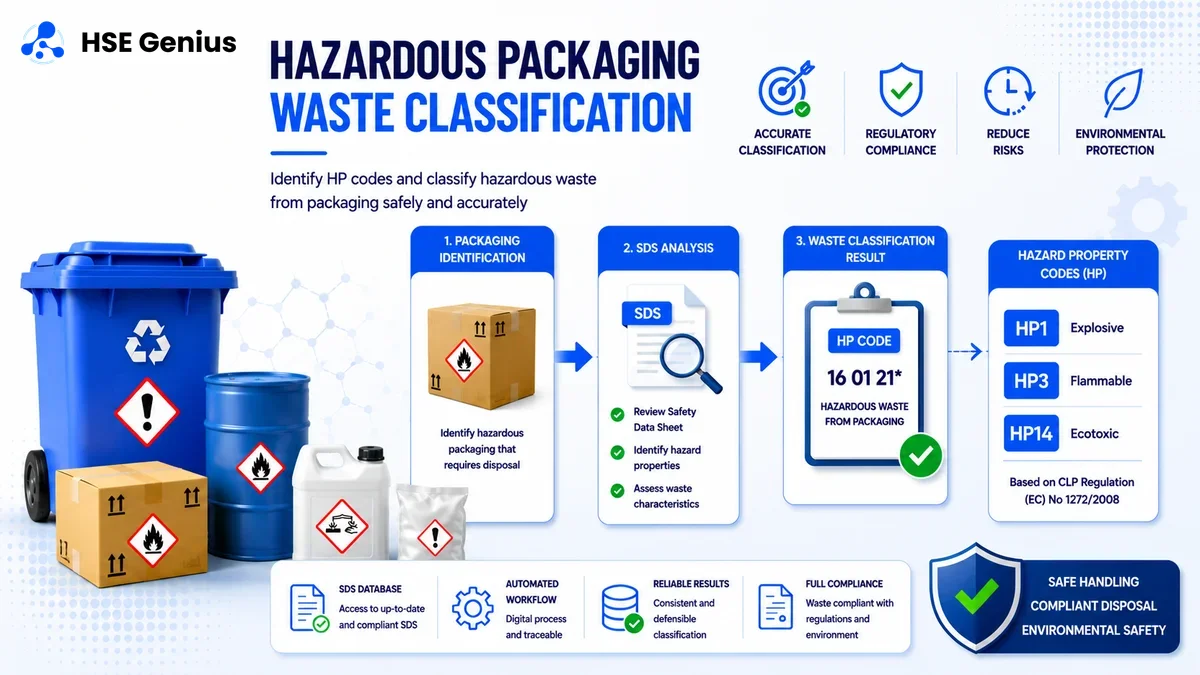
Hazardous packaging refers to containers that have held substances or mixtures classified as hazardous under the CLP Regulation (EC) No. 1272/2008.**Even if they appear empty, these packages may contain significant residues that pose risks to health and the environment.
In industrial and craft contexts, a container that has held a toxic paint, a flammable solvent, or a corrosive detergent must be managed as hazardous special waste.Correct classification is essential to avoid penalties, contamination, and improper disposal processes.
Content or container? The key criterion
The first aspect to assess in classification is whether to consider:
- The type of packaging
- The residual content
General rule:****If the packaging is not completely emptied, the classification follows the content.
Technical example:*A can with hazardous paint residues →🠖 EWC code 08 01 11 (paints containing organic solvents)
The role of Safety Data Sheets (SDS)
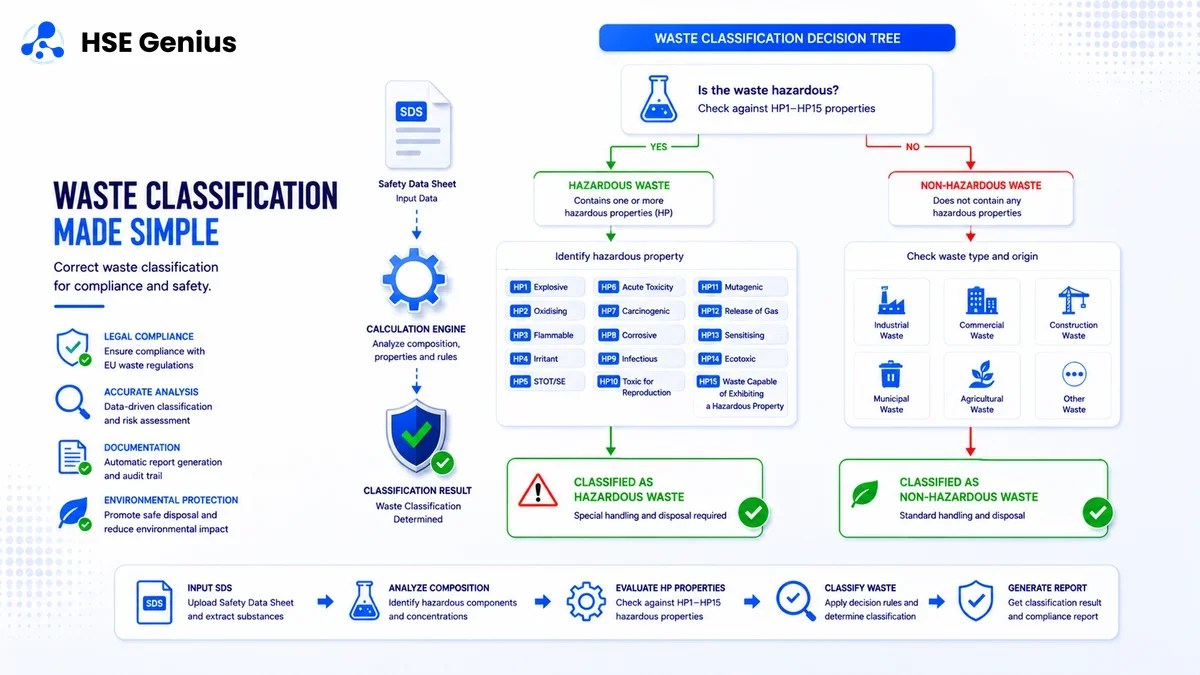
The Safety Data Sheet is the key document from which every classification process begins.**It provides all the information needed to analyze:
- Hazard statements (H) and pictograms (📌 Section 2)
- Substances present and their concentrations (📌 Section 3)
- Disposal guidance (📌 Section 13)
Using an up-to-date SDS is essential: it helps determine which risks remain in the packaging and which EWC codes to consider.
Steps for correct classification
Identify the contained substance****Retrieve the SDS of the original product. If it is a mixture, assess the residual hazard and the percentages of substances still present.
Assign the correct EWC code****Depending on the type of contamination and material, the most common codes for hazardous packaging are:
- 15 01 10*** → packaging contaminated by hazardous substances
- 15 01 11 → metallic packaging containing contaminated porous matrices
The asterisk (*) indicates that the waste is hazardous.
Common mistakes to avoid
 - Assuming that empty packaging is non-hazardous

 - Using outdated or incomplete SDS

 - Failing to document classification properly, putting compliance at risk
Even a formal mistake can lead to penalties or rejection by treatment plants.
Conclusion
The classification of hazardous packaging waste requires attention, method, and reliable tools.**Safety Data Sheets are the primary source to start from when evaluating residues and choosing the most appropriate EWC code.
Following this procedure ensures regulatory compliance, operational safety, and environmental responsibility.
👉 With HSE Genius**, accessing and using it correctly becomes simple.
**Want to know more?**Request a free demo or contact us to discover all the features.