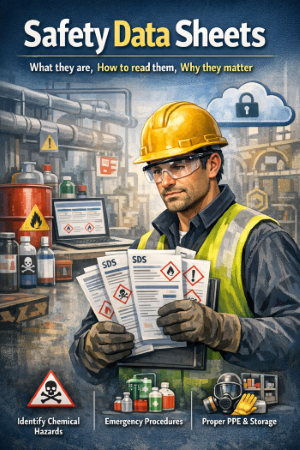
What is a Safety Data Sheet used for
Safety Data Sheets are essential for all companies that use industrial detergents, solvents, paints, reagents, additives, chemical mixtures, or other potentially hazardous substances.
An SDS is concretely used to:
identify hazards associated with the product;
determine required personal protective equipment (PPE);
verify correct storage conditions;
support chemical risk assessment;
define emergency procedures;
prevent handling errors;
properly manage waste resulting from product use.
Without proper reading of Safety Data Sheets, there is a real risk of underestimating exposures, chemical incompatibilities, and necessary preventive measures.
Who must provide the Safety Data Sheet
The Safety Data Sheet must be provided by the supplier of the substance or mixture when required by applicable regulations.
The document must be:
available in the local language (Italian for the Italian market);
consistent with product classification and labeling;
updated when new relevant information becomes available;
accessible to professional users of the product.
However, for companies, receiving it is not enough. It is necessary to verify that the SDS is up to date, complete, and specifically related to the product actually in use.
How to read a Safety Data Sheet
Many users search online for how to read a Safety Data Sheet, but often face long and highly technical documents. In reality, learning how to properly consult an SDS is essential for workplace safety.
Safety Data Sheets are structured into 16 standardized sections, each with a specific function:
Identification of the substance/mixture and of the company
Product name, recommended uses, and supplier details.
Hazard identification
Classification, pictograms, signal words, and main risks.
Composition/information on ingredients
Substance or mixture composition and relevant components.
First aid measures
Actions to take in case of contact, inhalation, or ingestion.
Firefighting measures
Suitable extinguishing media and combustion hazards.
Accidental release measures
Procedures in case of spills or leaks.
Handling and storage
Safe usage and storage instructions.
Exposure controls/personal protection
One of the most important sections, including exposure limits and recommended PPE.
Physical and chemical properties
Key technical characteristics.
Stability and reactivity
Conditions to avoid and possible hazardous reactions.
Toxicological information
Potential health effects.
Ecological information
Environmental impact data.
Disposal considerations
Proper waste management.
Transport information
ADR and other transport classifications.
Regulatory information
Applicable regulations.
Other information
Final notes, revisions, and hazard statement explanations.
Why Safety Data Sheets are important for chemical risk assessment
Chemical risk assessment starts from the information contained in Safety Data Sheets. Without these data, it is difficult to properly analyze hazards and implement appropriate prevention and protection measures.
SDS are used to:
identify hazardous chemical agents present in the workplace;
understand potential health effects on workers;
define safe operating procedures;
establish correct storage measures;
select appropriate PPE;
organize training and information for personnel.
For this reason, proper SDS management is an integral part of an effective HSE system.
Common mistakes in managing Safety Data Sheets
In many companies, the issue is not the absence of SDS, but how they are managed.
Archiving without analysis
SDS are often saved as PDFs and never consulted again.
Outdated documents
Using an old SDS can lead to incorrect assessments and inadequate measures.
Scattered information
When SDS are numerous, quickly retrieving key data becomes difficult.
Manual reading is too slow
Extracting information manually from dozens or hundreds of documents is time-consuming and error-prone.
Lack of integration with company processes
SDS should be linked to risk assessment, operational procedures, and document management systems.
Digital management of Safety Data Sheets: why it matters
Digitizing SDS management means transforming a static archive into a useful operational tool.
Key benefits include:
faster access to key information;
improved document organization;
reduced manual workload;
easier updates;
more effective support for chemical risk assessment;
lower risk of errors or omissions.
For HSE managers, safety officers, consultants, and plant managers, digital SDS management improves both operational efficiency and risk control.
Safety Data Sheets are essential tools for workplace safety, worker protection, and proper chemical management.
Understanding what Safety Data Sheets are, how to read them, and how to use them in chemical risk assessment allows companies to operate in a safer, more efficient, and more organized way.
Improving SDS management is not just about complying with documentation requirements, but about adopting a more modern and informed approach to safety.