


Related Articles




Latest Articles


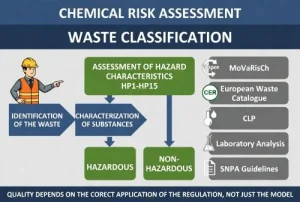
Waste ClassificationFrom H phrases to hazard characteristics HP according to Regulation (EU) No 1357/2014 and Regulation (EU) 2017/997
🚀 Try HSE Genius with 50 free credits
Start your free demo now and discover how easy SDS management can be.
Try the DemoRegulation (EU) No 1357/2014 replaces Annex III of Directive 2008/98/EC and defines the hazard characteristics of waste from HP1 to HP15. Subsequently, Regulation (EU) 2017/997 specifically amended only HP14 “Ecotoxic”, introducing the criteria currently in use. This regulation has been applicable since 5 July 2018.
HP 1 “Explosive”
Waste which may, by chemical reaction, develop gases at a temperature, pressure and speed which may cause damage to the surrounding area. This includes pyrotechnic waste, explosive organic peroxide waste and explosive self-reactive waste. Waste containing one or more substances classified with one of the hazard class and category codes and one of the hazard statement codes listed in Table 1 is assessed for the HP1 hazard characteristic, where appropriate and proportionate, using test methods. If the presence of a substance, mixture or article indicates that the waste is explosive, it is classified as hazardous waste of type HP 1.
Table 1 — Hazard class and category codes and hazard statement codes for waste components for the classification of waste as hazardous waste of type HP 1.
| HP | H | Hazard category | Limit % | Σ limit | Cut-off value (% w/w) |
|---|---|---|---|---|---|
| HP1 | H200 | Unst. Expl. | – | – | – |
| HP1 | H201 | Expl. 1.1 | – | – | – |
| HP1 | H202 | Expl. 1.2 | – | – | – |
| HP1 | H203 | Expl. 1.3 | – | – | – |
| HP1 | H204 | Expl. 1.4 | – | – | – |
| HP1 | H240 | Self-react. A | – | – | – |
| HP1 | H240 | Org. Perox. A | – | – | – |
| HP1 | H241 | Self-react. B | – | – | – |
| HP1 | H241 | Org. Perox. B | – | – | – |
HP 2 “Oxidising”
Waste capable, generally by providing oxygen, of causing or contributing to the combustion of other materials. Waste containing one or more substances classified with one of the hazard class and category codes and one of the hazard statement codes listed in Table 2 is assessed for the HP2 hazard characteristic, where appropriate and proportionate, using test methods. If the presence of a substance indicates that the waste is oxidising, it is classified as hazardous waste of type HP 2.
Table 2 — Hazard class and category codes and hazard statement codes for the classification of waste as hazardous waste of type HP 2.
| HP | H | Hazard category | Limit % | Σ limit | Cut-off value (% w/w) |
|---|---|---|---|---|---|
| HP2 | H270 | Ox. Gas 1 | – | – | – |
| HP2 | H271 | Ox. Liq 1 | – | – | – |
| HP2 | H271 | Ox. Sol 1 | – | – | – |
| HP2 | H272 | Ox. Liq 2 / Ox. Liq. 3 | – | – | – |
| HP2 | H272 | Ox. Sol 2 / Ox. Sol. 3 | – | – | – |
HP 3 “Flammable”
- Flammable liquid waste: liquid waste with a flash point lower than 60 °C, or gas oil, diesel fuels and light heating oils with a flash point higher than 55 °C and lower than or equal to 75 °C.
- Pyrophoric flammable solid and liquid waste: solid or liquid waste that can ignite in less than five minutes even in small quantities when in contact with air.
- Flammable solid waste: solid waste that is easily flammable or that can cause or contribute to fire through friction.
- Flammable gaseous waste: gaseous waste that ignites on contact with air at 20 °C and normal pressure of 101.3 kPa.
- Water-reactive waste: waste that, in contact with water, develops flammable gases in dangerous quantities.
- Other flammable waste: flammable aerosols, self-heating flammable waste, flammable organic peroxides and self-reactive flammable waste.
Waste containing one or more substances classified with one of the hazard class and category codes and one of the hazard statement codes listed in Table 3 is assessed, where appropriate and proportionate, using test methods. If the presence of a substance indicates that the waste is flammable, it is classified as hazardous waste of type HP 3.
Table 3 — Hazard class and category codes and hazard statement codes for waste components for the classification of waste as hazardous waste of type HP 3.
| HP | H | Hazard category | Limit % | Σ limit | Cut-off value (% w/w) |
|---|---|---|---|---|---|
| HP3 | H220 | Flam. Gas 1 | – | – | – |
| HP3 | H221 | Flam. Gas 2 | – | – | – |
| HP3 | H222 | Aerosol 1 | – | – | – |
| HP3 | H223 | Aerosol 2 | – | – | – |
| HP3 | H224 | Flam. Liq. 1 | – | – | – |
| HP3 | H225 | Flam. Liq. 2 | – | – | – |
| HP3 | H226 | Flam. Liq. 3 | – | – | – |
| HP3 | H228 | Flam. Sol. 1 | – | – | – |
| HP3 | H228 | Flam. Sol. 2 | – | – | – |
| HP3 | H242 | Self-react. CD / Org. Perox. CD | – | – | – |
| HP3 | H242 | Self-react. EF / Org. Perox. EF | – | – | – |
| HP3 | H250 | Pyr. Liq. 1 / Pyr. Sol. 1 | – | – | – |
| HP3 | H251 | Self-heat. 1 | – | – | – |
| HP3 | H252 | Self-heat. 2 | – | – | – |
| HP3 | H260 | Water-react. 1 | – | – | – |
| HP3 | H261 | Water-react. 2 / 3 | – | – | – |
Laboratories use HSE Genius
Trusted by professionals across Europe
See HSE Genius in Action
HP 4 “Irritant”
Skin irritation and eye damage: waste whose application may cause skin irritation or eye damage.
Waste containing one or more substances classified with one of the hazard class and category codes and one of the hazard statement codes listed in Table 4 is classified as hazardous waste of type HP 4 if the concentration limits shown in the table are met or exceeded.
The cut-off value to be considered for Skin corr. 1A (H314), Skin irrit. 2 (H315), Eye dam. 1 (H318) and Eye irrit. 2 (H319) is 1 %.
Table 4 — Hazard class and category codes and hazard statement codes for waste components for the classification of waste as hazardous waste of type HP 4.
| HP | H | Hazard category | Limit % | Σ limit | Cut-off value (% w/w) |
|---|---|---|---|---|---|
| HP4 | H314 | Skin corr. 1A* | 1 % | 1 ≤ ΣcH314 < 5 % → HP4 ΣcH314 ≥ 5 % → HP8 | 1 % |
| HP4 | H318 | Eye dam. 1 | 10 % | ΣcH318 ≥ 10 % → HP4 | 1 % |
| HP4 | H315 | Skin irrit. 2 | 20 % | ΣcH315 + ΣcH319 ≥ 20 % → HP4 | 1 % |
| HP4 | H319 | Eye irrit. 2 | 20 % | ΣcH315 + ΣcH319 ≥ 20 % → HP4 | 1 % |
Note: Waste containing substances classified as H314 (Skin corr. 1A, 1B or 1C) at ≥ 5 % is classified as HP 8. In this case the HP 4 hazard characteristic does not apply.
HP 5 “Specific target organ toxicity (STOT) / Aspiration hazard”
Waste which may cause specific target organ toxicity through a single or repeated exposure, or which may cause acute toxic effects following aspiration.
Waste containing one or more substances classified with one of the hazard class and category codes and one of the hazard statement codes listed in Table 5 is classified as hazardous waste of type HP 5 if the concentration limits shown in the table are met or exceeded.
Table 5 — Hazard class and category codes and hazard statement codes for waste components for the classification of waste as hazardous waste of type HP 5.
| HP | H | Hazard category | Limit % | Σ limit | Cut-off value (% w/w) |
|---|---|---|---|---|---|
| HP5 | H370 | STOT SE 1 | 1 % | – | – |
| HP5 | H371 | STOT SE 2 | 10 % | – | – |
| HP5 | H335 | STOT SE 3 | 20 % | – | – |
| HP5 | H372 | STOT RE 1 | 1 % | – | – |
| HP5 | H373 | STOT RE 2 | 10 % | – | – |
| HP5 | H304 | Asp. Tox. 1 | 10 % | ΣcH304 ≥ 10 % and kinematic viscosity at 40 °C ≤ 20.5 mm²/s → HP5 | – |
HP 6 “Acute toxicity”
Waste which may cause acute toxic effects following oral, dermal or inhalation exposure.
Waste containing one or more substances classified with one of the hazard class and category codes and one of the hazard statement codes listed in Table 6 is classified as hazardous waste of type HP 6 if the concentration limits shown in the table are met or exceeded.
Table 6 — Hazard class and category codes and hazard statement codes for waste components for the classification of waste as hazardous waste of type HP 6.
| HP | H | Hazard category | Limit % | Σ limit | Cut-off value (% w/w) |
|---|---|---|---|---|---|
| HP6 | H300 | Acute Tox. 1 (Oral) | 0.1 % | – | 0.10 % |
| HP6 | H300 | Acute Tox. 2 (Oral) | 0.25 % | Σc H300 (Acute Tox. 1 Oral) ≥ 0.25 % → HP6 | 0.10 % |
| HP6 | H301 | Acute Tox. 3 (Oral) | 5 % | Σc H301 ≥ 5 % → HP6 | 0.10 % |
| HP6 | H302 | Acute Tox. 4 (Oral) | 25 % | Σc H302 ≥ 25 % → HP6 | 1 % |
| HP6 | H310 | Acute Tox. 1 (Dermal) | 0.25 % | Σc H310 (Acute Tox. 1 Dermal) ≥ 0.25 % → HP6 | 0.10 % |
| HP6 | H310 | Acute Tox. 2 (Dermal) | 2.5 % | Σc H310 (Acute Tox. 2 Dermal) ≥ 2.5 % → HP6 | 0.10 % |
| HP6 | H311 | Acute Tox. 3 (Dermal) | 15 % | Σc H311 ≥ 15 % → HP6 | 0.10 % |
| HP6 | H312 | Acute Tox. 4 (Dermal) | 55 % | Σc H312 ≥ 55 % → HP6 | 1 % |
| HP6 | H330 | Acute Tox. 1 (Inhalation) | 0.1 % | – | 0.10 % |
| HP6 | H330 | Acute Tox. 2 (Inhalation) | 0.5 % | Σc H330 (Acute Tox. 2 Inhal.) ≥ 0.5 % → HP6 | 0.10 % |
| HP6 | H331 | Acute Tox. 3 (Inhalation) | 5 % | Σc H331 ≥ 5 % → HP6 | 0.10 % |
| HP6 | H332 | Acute Tox. 4 (Inhalation) | 25 % | Σc H332 ≥ 25 % → HP6 | 1 % |
HP 7 “Carcinogenic”
Waste which may cause cancer.
Waste containing one or more substances classified with one of the hazard class and category codes and one of the hazard statement codes listed in Table 7 is classified as hazardous waste of type HP 7 if the concentration limits shown in the table are met or exceeded.
Table 7 — Hazard class and category codes and hazard statement codes for waste components for the classification of waste as hazardous waste of type HP 7.
| HP | H | Hazard category | Limit % | Σ limit | Cut-off value (% w/w) |
|---|---|---|---|---|---|
| HP7 | H350 | Carc. 1A | 0.1 % | – | – |
| HP7 | H350 | Carc. 1B | 0.1 % | – | – |
| HP7 | H351 | Carc. 2 | 1 % | – | – |
HP 8 “Corrosive”
Waste which, on contact with living tissue, may destroy it.
Waste containing one or more substances classified with one of the hazard class and category codes and one of the hazard statement codes listed in Table 8 is classified as hazardous waste of type HP 8 if the concentration limits shown in the table are met or exceeded.
Table 8 — Hazard class and category codes and hazard statement codes for waste components for the classification of waste as hazardous waste of type HP 8.
| HP | H | Hazard category | Limit % | Σ limit | Cut-off value (% w/w) |
|---|---|---|---|---|---|
| HP8 | H314 | Skin corr. 1A / 1B / 1C | 5 % | ΣcH314 ≥ 5 % → HP8 | 1 % |
HP 9 “Infectious”
Waste containing viable micro-organisms or their toxins which are known or reliably believed to cause disease in humans or other living organisms.
This property is assessed on a case-by-case basis according to the criteria of the WHO or national regulations.
HP 10 “Reproductive toxicity”
Waste which may cause reproductive toxicity.
Waste containing one or more substances classified with one of the hazard class and category codes and one of the hazard statement codes listed in Table 10 is classified as hazardous waste of type HP 10 if the concentration limits shown in the table are met or exceeded.
Table 10 — Hazard class and category codes and hazard statement codes for waste components for the classification of waste as hazardous waste of type HP 10.
| HP | H | Hazard category | Limit % | Σ limit | Cut-off value (% w/w) |
|---|---|---|---|---|---|
| HP10 | H360 | Repr. 1A | 0.3 % | – | – |
| HP10 | H360 | Repr. 1B | 0.3 % | – | – |
| HP10 | H361 | Repr. 2 | 3 % | – | – |
HP 11 “Mutagenic”
Waste which may cause heritable genetic defects or increase their incidence.
Waste containing one or more substances classified with one of the hazard class and category codes and one of the hazard statement codes listed in Table 11 is classified as hazardous waste of type HP 11 if the concentration limits shown in the table are met or exceeded.
Table 11 — Hazard class and category codes and hazard statement codes for waste components for the classification of waste as hazardous waste of type HP 11.
| HP | H | Hazard category | Limit % | Σ limit | Cut-off value (% w/w) |
|---|---|---|---|---|---|
| HP11 | H340 | Muta. 1A | 0.1 % | – | – |
| HP11 | H340 | Muta. 1B | 0.1 % | – | – |
| HP11 | H341 | Muta. 2 | 1 % | – | – |
HP 12 “Aspiration hazard”
Waste which may cause aspiration hazard.
Waste containing one or more substances classified with one of the hazard class and category codes and one of the hazard statement codes listed in Table 12 is classified as hazardous waste of type HP 12 if the concentration limits shown in the table are met or exceeded.
Table 12 — Hazard class and category codes and hazard statement codes for waste components for the classification of waste as hazardous waste of type HP 12.
| HP | H | Hazard category | Limit % | Σ limit | Cut-off value (% w/w) |
|---|---|---|---|---|---|
| HP12 | H304 | Asp. Tox. 1 | 10 % | ΣcH304 ≥ 10 % and kinematic viscosity ≤ 20.5 mm²/s → HP12 | – |
HP 13 “Sensitising”
Waste which may cause sensitisation by inhalation or skin contact.
Waste containing one or more substances classified with one of the hazard class and category codes and one of the hazard statement codes listed in Table 13 is classified as hazardous waste of type HP 13 if the concentration limits shown in the table are met or exceeded.
Table 13 — Hazard class and category codes and hazard statement codes for waste components for the classification of waste as hazardous waste of type HP 13.
| HP | H | Hazard category | Limit % | Σ limit | Cut-off value (% w/w) |
|---|---|---|---|---|---|
| HP13 | H334 | Resp. Sens. 1 | 0.2 % | – | – |
| HP13 | H334 | Resp. Sens. 1B | 1 % | – | – |
| HP13 | H317 | Skin Sens. 1 | 1 % | – | – |
| HP13 | H317 | Skin Sens. 1B | 10 % | – | – |
HP 14 “Ecotoxic”
Waste which presents or may present immediate or delayed risks for one or more sectors of the environment.
This characteristic was updated by Regulation (EU) 2017/997.
Waste containing one or more substances classified with one of the hazard class and category codes and one of the hazard statement codes listed in Table 14 is classified as hazardous waste of type HP 14 if the concentration limits shown in the table are met or exceeded.
Table 14 — Hazard class and category codes and hazard statement codes for waste components for the classification of waste as hazardous waste of type HP 14.
| HP | H | Hazard category | Limit % | Σ limit | Cut-off value (% w/w) |
|---|---|---|---|---|---|
| HP14 | H400 | Aquatic Acute 1 | 0.1 % | ΣcH400 ≥ 0.1 % → HP14 | 0.1 % |
| HP14 | H410 | Aquatic Chronic 1 | 0.1 % | ΣcH410 ≥ 0.1 % → HP14 | 0.1 % |
| HP14 | H411 | Aquatic Chronic 2 | 1 % | ΣcH411 ≥ 1 % → HP14 | 0.1 % |
| HP14 | H412 | Aquatic Chronic 3 | 10 % | ΣcH412 ≥ 10 % → HP14 | 0.1 % |
| HP14 | H413 | Aquatic Chronic 4 | 25 % | ΣcH413 ≥ 25 % → HP14 | 0.1 % |
HP 15 “Waste capable of exhibiting a hazardous property”
Waste which does not directly possess any of the hazard characteristics mentioned above but may exhibit one of them subsequently.
Waste containing one or more substances marked with one of the hazard statements or supplementary hazard information listed in Table 15 is classified as hazardous waste with code HP 15, unless it is in a form such that it cannot under any circumstances exhibit explosive or potentially explosive characteristics.
Table 15 — Hazard statements and supplementary hazard information for waste components for the classification of waste as hazardous waste of type HP 15.
| HP | H | Hazard statement / Supplementary information | Limit % | Σ limit | Cut-off value (% w/w) |
|---|---|---|---|---|---|
| HP15 | H205 | May mass explode in fire | – | – | – |
| HP15 | EUH001 | Explosive when dry | – | – | – |
| HP15 | EUH019 | May form explosive peroxides | – | – | – |
| HP15 | EUH044 | Risk of explosion if heated under confinement | – | – | – |
Member States may also assign the hazard characteristic HP 15 to a waste on the basis of other applicable criteria, such as the evaluation of the leaching product.
Notes Σ = sum and c = concentrations of the substances.
(*) Regulation (EC) No 1272/2008 of the European Parliament and of the Council of 16 December 2008 on classification, labelling and packaging of substances and mixtures, amending and repealing Directives 67/548/EEC and 1999/45/EC, and amending Regulation (EC) No 1907/2006 (OJ L 353, 31.12.2008, p. 1).
100+ laboratories already use
Hse Genius
Trusted by laboratories and professionals across Europe
Interfaccia chiara e dati subito disponibili in Excel.

Übersichtliche Oberfläche und Daten sofort in Excel verfügbar.

HSE Genius ci ha aiutato a velocizzare l’analisi delle SDS.

Ready to simplify your SDS workflow?
Get started with HSE Genius today – try the free demo or contact us for details.
📩 Request Info or Book a Demo
Want to see HSE Genius in action? Fill out the form below.