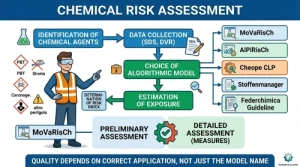
MoVaRisCh: The Most Well-Known Model in Operational Practice
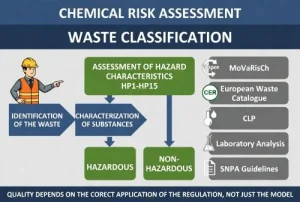
Among the most cited models in Italian practice is MoVaRisCh, an acronym for Modello di Valutazione del Rischio Chimico (Chemical Risk Assessment Model). In operational practice, it is used to carry out a preliminary assessment of chemical risk for health through an algorithm that crosses danger and exposure. Training materials from Tuscan health structures explicitly reference it as a tool for preliminary assessment and confirm its update to the European REACH and CLP regulations.
MoVaRisCh’s strength lies in its relative simplicity of application. The model helps to transform information present in safety data sheets and operating conditions into a risk index useful for a first classification of tasks and activities. For this reason, it is highly appreciated, especially in small and medium-sized enterprises and in contexts where it is not realistic to immediately start extensive measurement campaigns.
That said, MoVaRisCh should not be considered a “shortcut”. As with all algorithmic models, the result heavily depends on the quality of the data entered: quantities actually used, exposure time, application method, ventilation, temperature, dispersion, skin contact, correct use of PPE. If this data is approximate, the final index risks being so too. This is a technical deduction consistent with the fact that models are indicated as supports for exposure estimation, not as automatic substitutes for professional judgment.
AlPiRisCh: The Piedmontese Model
AlPiRisCh, that is, Algoritmo Piemontese Rischio Chimico (Piedmontese Chemical Risk Algorithm), is one of the most structured Italian references. The Piedmont Region presents it as an operational tool for assessing risk deriving from the presence of chemical substances in the work environment, excluding carcinogenic and mutagenic substances. The 2016 regional document specifies that the model replaces the previous version and describes both a simplified “cut off” methodology and a more detailed pathway with an inhalation and skin risk index.
An interesting element of AlPiRisCh is its multi-level logic. First, it checks if consolidated data or conditions exist that require a detailed assessment; then it provides for a simplified phase for clearly low-criticality scenarios; finally, when necessary, it passes to a more in-depth estimation of risk by inhalation and skin contact. In the Piedmontese document, “cut off” is admitted only in the presence of very specific conditions, for example, low-criticality substances or mixtures, low availability, absence of factors favoring dispersion, and quantities less than 100 grams per day per worker.
Cheope CLP, Stoffenmanager, and Federchimica Guideline
The technical material referring to the UNI/TR 11707:2018 Technical Report also lists other models of practical interest: Cheope CLP, Stoffenmanager, and the Federchimica Guideline. Cheope CLP is described as a model that allows for the assessment of health and safety risks, also for the combined use of chemical agents, based on numerical hazard and risk indices. Stoffenmanager, on the other hand, is a tool very well-known also at a European level, oriented towards exposure estimation and risk management. The Federchimica Guideline represents a further reference for structured industrial contexts.
From a practical point of view, these models are not all equivalent. Some are more suitable for a rapid preliminary assessment, others for more complex production realities or for integration with more advanced exposure data and use scenarios. The choice should therefore not be based on name recognition, but on consistency with the production process, the level of internal competence, and the availability of reliable data. This conclusion is consistent with the setting of the UNI document referenced, which declares informative purposes and support for choosing the most suitable model for the specific work reality.
What About European Models Like ECETOC TRA?
Alongside the Italian models, INAIL also recalls European tools such as ECETOC TRA, used for estimating professional exposure to chemical agents and often linked to REACH exposure scenarios. These tools can be particularly useful when working with extended safety data sheets, structured use scenarios, or company contexts that are more advanced in terms of regulatory management. However, in the practice of many Italian SMEs, national algorithmic models often remain more immediate and simpler to integrate into the Risk Assessment Document (DVR).
The Role of the Competent Physician and Measurements
Chemical risk assessment is not just a calculation exercise. In cases where health surveillance is necessary, the competent physician must collaborate in assessing risks and defining prevention measures. Technical materials from the Local Health Authorities (AUSL) recall that the competent physician contributes to reading safety data sheets, mapping risk, choosing any environmental and biological monitoring, and defining the health protocol.
Furthermore, when the model signals situations that are not irrelevant or when there are critical indicators, the assessment must be in-depth with measurements, monitoring, or more timely analyses. Even AlPiRisCh explicitly provides, in some cases, for the passage from an algorithmic estimation to an algorithm based on measured exposure or to periodic verifications.
Which Model to Choose?
There is no “best” model overall. The most suitable model for the context exists. In very practical terms:
MoVaRisCh is often chosen when an orderly, rapid, and fairly intuitive preliminary assessment is needed, especially in SMEs.
AlPiRisCh is more structured and methodologically very solid, particularly useful when wanting to follow a pathway that distinguishes a simplified phase, inhalation risk, skin risk, and possible integration with measured data.
Cheope CLP, Stoffenmanager, and the Federchimica Guideline may be preferable in more advanced contexts, in companies with greater technical support, or where a more integrated approach with exposure scenarios and advanced risk management is useful.
Chemical risk assessment should never be reduced to a formal fulfillment. Models such as MoVaRisCh, AlPiRisCh, Cheope CLP, or other estimation tools are extremely useful, but they must be used as part of a broader process that includes analysis of substances, observation of processes, verification of real exposure, technical measures, training, PPE, health surveillance, and, when necessary, environmental or biological monitoring. The true quality of the DVR does not depend on the name of the model chosen, but on its correct application and ability to transform assessment into concrete prevention.