

Have you ever seen piles of empty drums in a storage area and thought, “What a waste”?
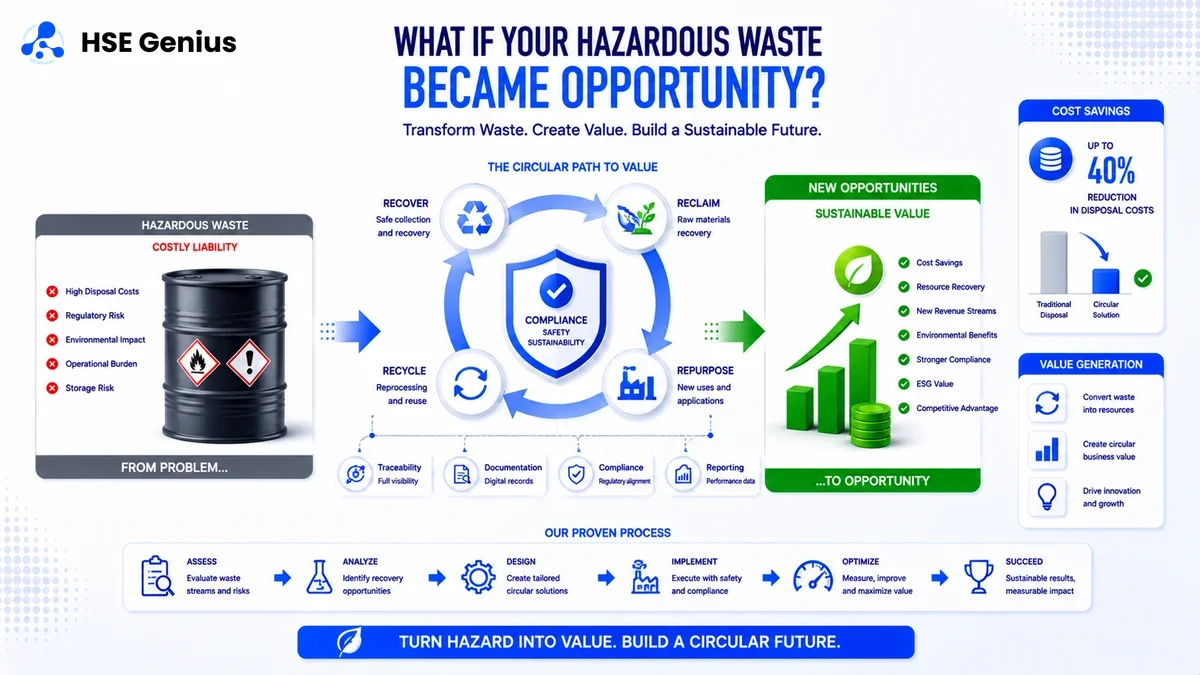
Every liter of solvent and every ton of sludge represents potential costs and risks — but also new sources of value. In this article, we explore how the circular economy can revolutionize hazardous waste management.
1. Why the circular economy is the key
The circular economy goes beyond “recycling”: it reintroduces materials into the production cycle, reducing disposal and environmental impacts.
- Economic benefit: up to 60% reduction in disposal costs.
- Environmental benefit: fewer emissions and less resource extraction.
- Regulatory benefit: easier compliance with EU directives and national legislation (e.g., D.Lgs. 152/2006).
2. The practical transformation of solvents
Imagine regenerating your spent solvents to 95% purity. Even a small plant can return hundreds of thousands of euros in value each year, reducing both the purchase of new solvent and disposal costs. Distillation and purification technologies, combined with laboratory analysis, ensure consistent results.
3. Extracting precious metals from sludge
Metals like nickel, chromium, and copper are not waste — they are resources. Electrolytic processes and selective chemical solutions make it possible to recover them from industrial sludge. Beyond the economic savings, you reduce dependence on foreign markets and increase the sustainability of your production cycle.