🚀 Want to try HSE Genius?

📋 Compliance & Regulations

New CLP Hazard Classes

2026-03-22|2 min read|HSE Genius
New CLP Hazard Classes — HSE Genius

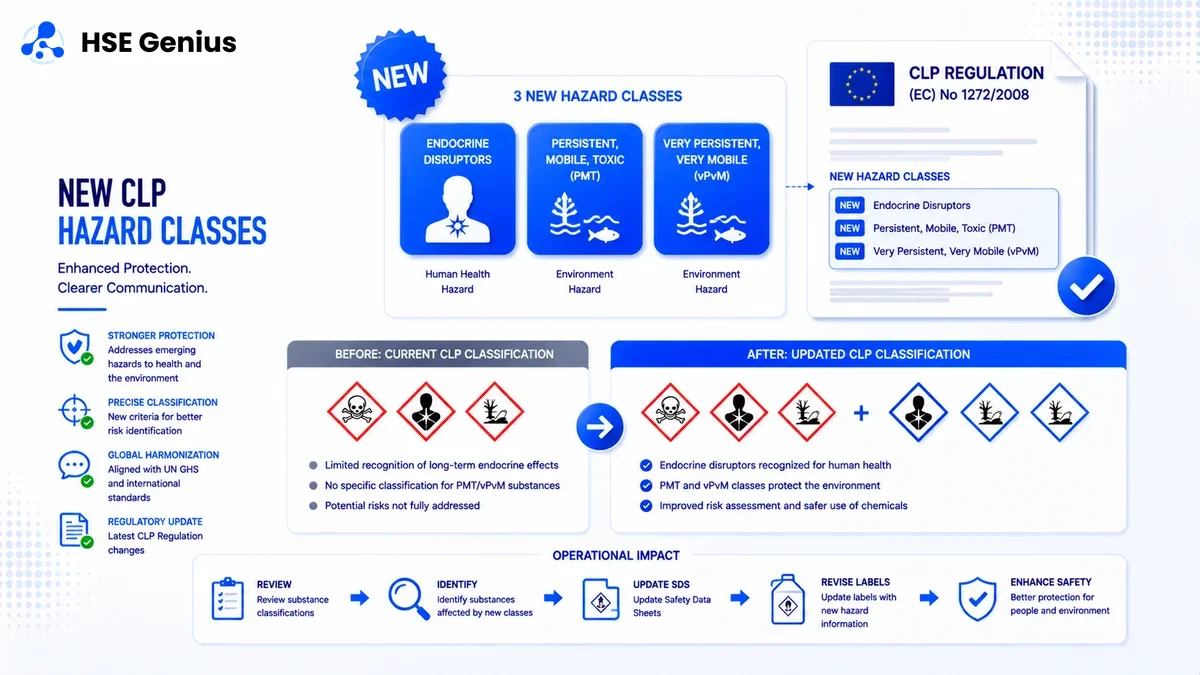
The introduction of new hazard classes within the CLP Regulation framework represents one of the most significant innovations in chemical substance management

The introduction of new hazard classes within the CLP Regulation framework represents one of the most significant innovations in chemical substance management in recent years. With Delegated Regulation (EU) 2023/707, the European Union integrated new categories into the CLP system concerning, among others, endocrine disruptors and PBT, vPvB, PMT, and vPvM substances, expanding the scope of assessments required from manufacturers, importers, and downstream users.

The effect of this innovation is not confined to the theoretical level of classification. Indeed, the new hazard classes have a direct impact on the contents of Safety Data Sheets (SDS), as every new classification necessitates a review of the information to be provided regarding hazards, preventive measures, ecotoxicological data, and risk management measures.

The application deadlines confirm the relevance of 2026. For new substances on the market, the application of the new classes already started on May 1, 2025; for new mixtures, the operational reference is May 1, 2026, while extended transitional periods apply to numerous mixtures already present on the market. This makes 2026 a particularly sensitive year for companies that market or use complex formulations.
HSE Genius

Stop analysing SDS manually.

50 free credits, no credit card required.

🚀 Start free

From a management perspective, the critical challenge lies in the ability to promptly identify which products are affected by the new classifications and which SDS must be revised. Without a structured control system, there is a risk of keeping in circulation SDS that are formally correct in terms of format, but no longer fully adequate regarding the content required by the updated regulations.

The new hazard classes therefore confirm an essential principle: SDS compliance does not only depend on adopting a correct template, but above all on the quality of the process by which information is reviewed, updated, and transferred into the documents destined for the supply chain.

HSE Genius Platform

Manage SDS faster and more accurately

HSE Genius automates SDS analysis, CLP classification and waste management. Start for free.

50 free credits · no card required

Related articles

How it works in 3 seconds

sds_
file.pdf

AI analysis…

sds_file.pdf✓ Extracted
H225Highly flammable liquid
HP3Flammable waste
ECHA✓ Verified

PDF → AI → H codes, HP, ECHA verification

System live now

Safety data sheets analyzed

35.500

↑ updated in real time

Try now — 50 free credits

No credit card required