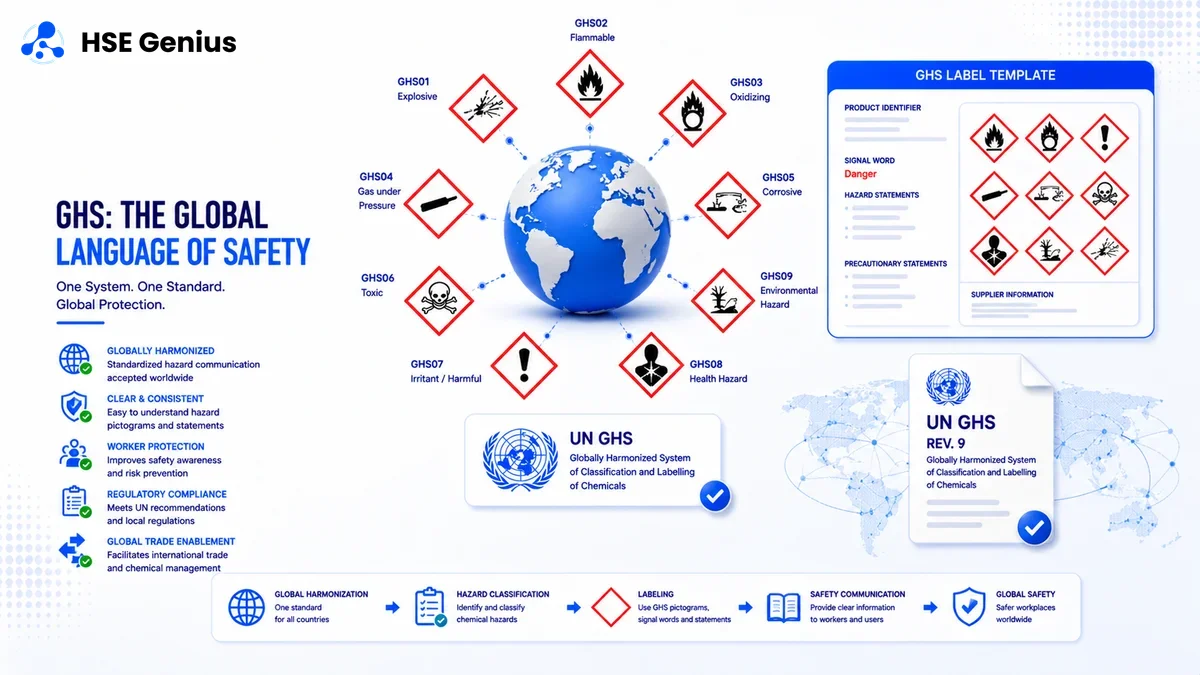
The GHS (Globally Harmonized System) is the international reference framework for classifying, labeling, and communicating hazards related to chemical substances. It was created to provide a consistent structure, valid across industrial, environmental, and logistics contexts. Symbols, H and P statements, SDS sheets: each element follows a precise model designed to be understood worldwide. This improves safety, increases document readability, and reduces errors. The GHS thus becomes a shared technical language, applicable to any sector where hazardous products or waste circulate. Clarity and standardization are its strengths.
Where GHS applies worldwide
The GHS is currently adopted in many countries and integrated into local regulatory systems. The European Union applies it through the CLP Regulation, the United States through OSHA standards, while countries like China and Japan have developed national versions based on the same scheme. Worldwide, safety professionals, laboratories, and industries use it to ensure consistency and compliance. Each country may vary slightly in details (language, format, mandatory statements), which is why updated tools are essential.
Purpose and benefits of GHS
The GHS enables more effective and organized management of hazardous substances through three key instruments:
- Labels with clear, unified pictograms
- SDS sheets structured into standard sections
- Codified hazard (H) and precautionary (P) statements
These elements improve internal communication, facilitate staff training, and simplify regulatory compliance. Every process connected to chemical safety becomes more streamlined and verifiable. The GHS reduces ambiguity, optimizes reading time, and makes documents more accessible for operators, technicians, and auditors—a concrete advantage for every company focused on quality and prevention.
Who benefits from GHS
The GHS is valuable not only for those directly handling chemicals but also for those managing their data or documentation. In particular, it serves as a reference for:
- HSE professionals
- Environmental managers or quality managers
- Waste management operators and consultants
Every figure involved in production, environmental, or logistics processes can apply GHS to improve classification, risk management, and data quality. Using this standard means acting with greater accuracy, reliability, and method.
Automated efficiency with HSE Genius
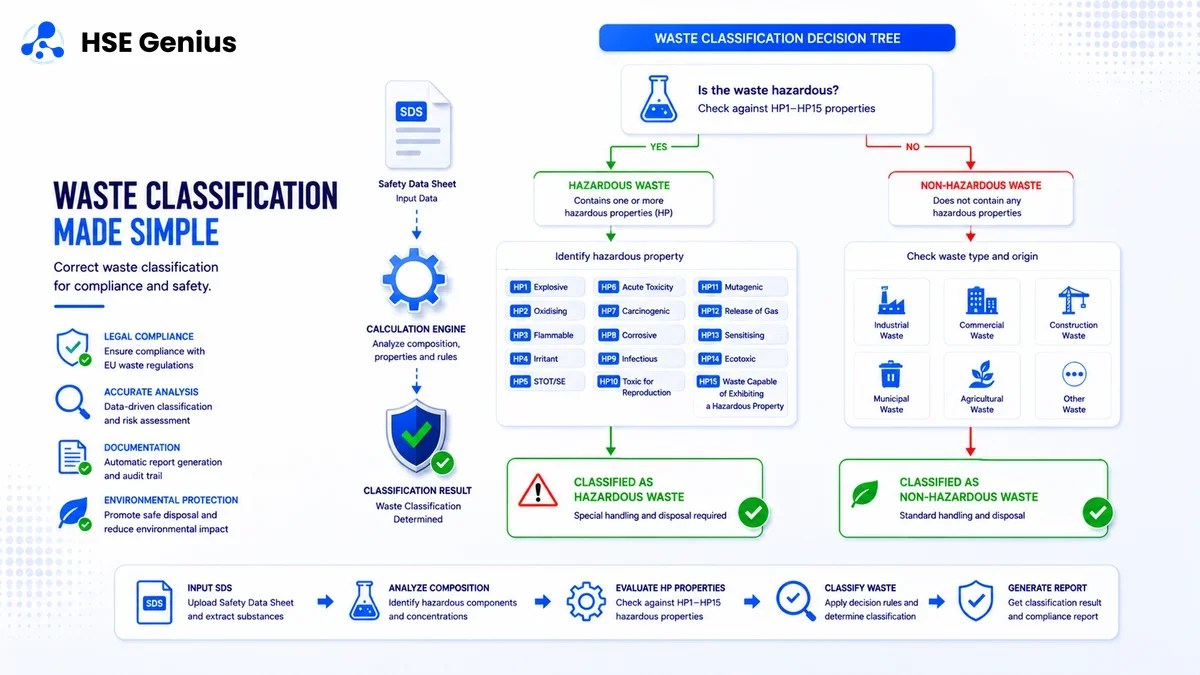
HSE Genius applies GHS digitally, quickly, and reliably. The system automatically analyzes SDS, extracts H statements, calculates HP hazard classes, and suggests the most suitable EWC code. In just a few seconds, it provides a clear, structured output ready for archiving or verification. This drastically reduces operational time, improves data quality, and simplifies every stage of the process. HSE Genius is a strategic ally for professionals aiming to intelligently manage technical documentation and enhance control in environmental management.
Quick overview of GHS pictograms
GHS pictograms are essential symbols for immediately and uniformly communicating the risks of chemical substances. Here are the nine standard red-diamond icons:
- Explosive
- Flammable
- Oxidizing
- Gas under pressure
- Corrosive
- Acute toxicity
- Health hazard
- Environmental hazard
- Irritant
Each pictogram includes a GHS code (e.g., GHS02, GHS05, GHS06) to ensure consistency between SDS and labels.
The GHS unifies chemical safety worldwide. Applying it carefully means improving processes and protecting both people and the environment. Thanks to automation, tools like HSE Genius transform every SDS into an intelligent, organized, and compliant archive.
👉 With HSE Genius, consulting and using SDS the right way becomes simple.
**Want to know more?**Request a free demo or contact us to explore all features.