Related Articles
Latest Articles
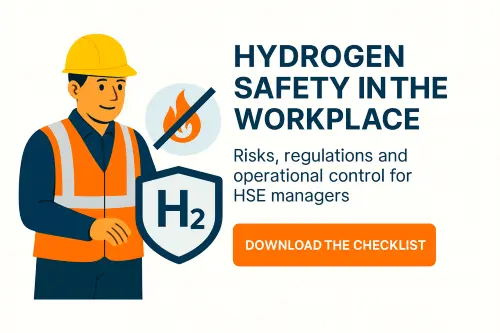
Hydrogen Safety in the Workplace
🚀 Try HSE Genius with 50 free credits
Start your free demo now and discover how easy SDS management can be.
Try the DemoReal Risks and What to Do Now
Giulia, the HSE manager at a plant integrating a small electrolyzer to produce hydrogen for industrial furnaces, applies the precautionary principle. Before starting up the system, she requests a safety review, updates the emergency plan, and organizes short training for the technicians. That day Giulia turns uncertainty into operational control, making the site ready for the new energy challenge.
This article explains, with a practical and direct tone for HSE managers, why hydrogen requires attention today, which rules and guidelines to follow, which mistakes to avoid, and which concrete actions to implement immediately.
What Hydrogen Is and Where It Is Found in Industry
Hydrogen is the fastest-growing energy carrier in the industrial sector.
It is used as:
a chemical feedstock,
a fuel for thermal processes,
an energy storage medium,
a source for fuel cells.
Hydrogen offers advantages such as high energy density by mass, but also properties that require strict controls: it is lightweight, has a wide flammability range, disperses quickly in open spaces, and tends to accumulate in confined areas if ventilation is insufficient. Allianz Commercialh2tools.org
Current Standards and Guidelines (What to Follow Immediately)
The design, installation, and operation of hydrogen systems are based on internationally recognized technical codes and European guidelines:
NFPA 2, Hydrogen Technologies Code provides technical requirements for hydrogen generation, storage, piping, and use (2023 edition with ongoing technical updates). nfpa.org
In Europe, the Clean Hydrogen / European Hydrogen Safety Panel (EHSP) publishes guidelines and safety plan templates for EU-scale projects. These documents support risk planning and assessment for electrolysis and storage initiatives. Clean Hydrogen Partnership
National authorities (e.g., HSE UK) integrate regulations such as DSEAR and provide operational tools for area classification and ignition source management. hse.gov.uk – solutions.hse.gov.uk
These sources form the foundation for the technical and procedural decisions every HSE manager should adopt.
Real Risks and Case-Based Lessons (Operational Takeaways)
Technical literature and specialist reports highlight the possibility of jet fires, deflagrations, and explosions if hydrogen is released under unfavorable conditions. Probabilistic studies show scenarios with significant damage likelihood in the event of failures in high-pressure systems.
These analyses lead to three concrete lessons for the field: design systems to limit the amount of hydrogen stored in enclosed spaces, ensure effective ventilation, and install rapid detection/isolation systems. Major project incidents and recommendations from international bodies have also driven the update of technical codes and procedures.
The Department of Energy’s Energy.gov
What This Means for a Company (Operational Impact)
For a company, the introduction of hydrogen requires: more in-depth design assessments, updated permits, specialized training for maintenance staff, specific emergency plans, and active involvement of regulatory authorities.
This commitment translates into clearer role definitions, the establishment of engineering measures (volume limitations, shielding, shut-off valves), and written procedures shared with suppliers and local fire brigades.
Laboratories use HSE Genius
Trusted by professionals across Europe
See HSE Genius in Action
The Consequences of Underestimating Risk
Shifting management to an improvised basis increases the likelihood of major events and impacts worker safety, production continuity, and legal responsibilities. Underestimating risk also leads to difficulties in dealings with insurers and delays in the authorization process when projects require downstream technical adjustments.
A proactive approach reduces both costs and overall timelines for the adoption of hydrogen technologies.
Who Is Most Exposed (Roles and Locations)
The profiles at highest risk include: maintenance teams, machine room operators, warehouse managers where cylinders or cylinder packs are stored, logistics managers organizing cylinder transport, and project teams installing electrolyzers or storage systems.
Sensitive areas include technical rooms, pump rooms, piping interconnections, and spaces beneath platforms where light gases tend to accumulate.
Practical Actions, Step by Step (Operational Guide for HSE Managers)
Preliminary Safety Review: before any installation, request an independent safety review covering layout, stored quantities, and release scenarios. Use the EHSP templates to ensure a shared and standardized structure. Clean Hydrogen Partnership
Limit Quantities and Segregate:
Apply the ALARP principle (as low as reasonably practicable) to the amount of hydrogen stored indoors, and ensure safety volumes and setbacks in accordance with NFPA 2.
Ventilation and Detection: Design natural or forced ventilation together with an H₂ detection system; configure automatic isolation logic and alarm shutdown functions.
LOTO Procedures and Work Permits: Integrate specific LOTO procedures for pressurized systems and clearly define responsibilities for interventions on piping and valves.
Targeted Training:
Train internal teams on leak recognition, the use of portable monitors, and managing hydrogen fires (including drills with the Fire Brigade).
Emergency Plan and Coordination with First Responders:
Coordinate a procedure with the Fire Brigade and local emergency services, including risk maps, threshold concentrations, and evacuation scenarios.
Audit and Continuous Review: Establish KPIs (monthly inspections, response time, number of drills per year) and regularly update plans based on lessons learned and regulatory updates
Are There Official Procedures for Storage and Disposal? (and for Transport?)
Yes. Technical and regulatory procedures are numerous and specific to the application — from plant design to storage, up to transport. In particular:
NFPA 2 provides design and fire protection requirements for fixed installations. nfpa.org
In Europe, the Clean Hydrogen / EHSP offers guidance and safety plan templates for projects and installations. Clean Hydrogen Partnership
National regulations (e.g., DSEAR in the UK) require risk assessment and classification of explosive areas for light gases such as hydrogen. hse.gov.uk
Transport Requirements
For transport, hydrogen follows specific technical codes depending on the mode: compressed or cryogenic for road transport, maritime transport regulations, and air transport guidelines where applicable. In all cases, compliance with international standards (ASME, ISO, NFPA, and ASME B31.12 pipeline standards for hydrogen) is part of technical compliance.
The Department of Energy’s Energy.govapiproxy.utc.wa.gov
Quick Checklist (to Integrate into Your HSE System)
Preliminary safety review Clean Hydrogen Partnership
Limiting Stored Quantities and Calculating Setbacks According to NFPA 2
H₂ Ventilation and Detection Installed and Tested WHA International, Inc.
Integrate LOTO procedures and clear work permits for pressurized systems.
Coordinate with Fire Brigade including risk maps and evacuation scenarios.solutions.hse.gov.uk
Leak/Anomaly Log and Tracked Corrective Actions
Transport Plans and Documentation for Cylinder/Bundle Handling (Compliance with ASME/ADR/IMDG Where Applicable) apiproxy.utc.wa.gov
What to Do Today, Immediately
Schedule an external safety review for the most critical hydrogen project on site.
Update the emergency plan with H₂ scenarios and contact the local Fire Brigade for a drill.
Start an inventory of hydrogen quantities on site and apply temporary limits until design reviews are completed.
Main Sources Consulted (for Further Reading):
HSE — Dangerous Substances and Explosive Atmospheres Regulations (DSEAR), and page hydrogen safety. hse.gov.uksolutions.hse.gov.uk
Clean Hydrogen / European Hydrogen Safety Panel — guidance and safety planning documents. Clean Hydrogen Partnership+1
NFPA 2 — Hydrogen Technologies Code (2023 edition and updates). nfpa.orgdocinfofiles.nfpa.org
Technical studies and reviews on explosion probability, jet fire, and risk mitigation. ScienceDirectMDPI
Documents on Codes and Standards (ASME / Pipeline / Transport Standards) and International Guidelines
👉 With HSE Genius, consulting and using it correctly becomes simple.
Want to learn more?
Request a free demo or contact us to discover all its features.
200+ laboratories already use
Hse Genius
Trusted by laboratories and professionals across Europe
Interfaccia chiara e dati subito disponibili in Excel.
Übersichtliche Oberfläche und Daten sofort in Excel verfügbar.
HSE Genius ci ha aiutato a velocizzare l’analisi delle SDS.
Ready to simplify your SDS workflow?
Get started with HSE Genius today – try the free demo or contact us for details.
📩 Request Info or Book a Demo
Want to see HSE Genius in action? Fill out the form below.